Decarbonizing Transport with Carbon Offsets
Under its Nationally Determined Contributions (NDCs), India now stands committed to reducing the Emissions Intensity of its GDP by 45 per cent by 2030, from the 2005 level and achieving net zero by 2070. The Energy Conservation (Amendment) Act’2022 aims to manoeuvre India on the right track. The Act gave a green signal to Central Government for the creation of a carbon credit trading scheme. BloombergNEF research report opines that the total value of carbon credits produced and sold could reach $1 Trillion by 2037. Thus, participation in the carbon trading market is prudent both from an environmental and commercial angle.
India’s per capita emissions currently stand at a mere 1.8 Tons of CO2e (versus the USA at 14.7 and China at 7.6). However, India is the world’s third-largest emitter at 2.9 Giga Tons CO2 equivalent (around 4.9% of global emissions). Article 17 of the Kyoto Protocol allows countries that have emission units to spare - emissions permitted to them but not "used" - to sell this excess capacity to countries that are beyond their targets thus enabling emissions trading. The same got reaffirmed in Article 6 of the Paris Agreement. India leads the pack, accounting for 40-50% of annual carbon credits sales and having 1685 projects registered under UNFCCC’s CDM (Clean Development Mechanism) as of Mar’2022.
According to India's Third Biennial Update Report (2021) to UNFCCC, the transport sector is estimated to have contributed to 274 million tonnes of CO2 equivalent emissions per year in 2016, accounting for roughly 11% of the total emissions generated by the entire economy. Around 70% of freight movement and 90% of passenger movement can be attributed to the road sector alone, which is the most carbon-intensive mode of all available options. Rail freight typically produces lower emissions per tonne-km than road freight, mainly due to the more fuel-efficient locomotives and the lower rolling resistance of trains compared to trucks. Therefore, the potential for rail systems to earn Carbon Credits is immense owing to their low carbon emission intensity (approx. 23 per cent of roadways).
The Delhi Metro has earned 4.4 million carbon credits which were generated through innovative technologies of regenerative braking etc. and due to Modal Shift. Following the suit, in Dec 2022, the Ministry of Housing and Urban Affairs advised metro rail corporations to register for carbon credits.
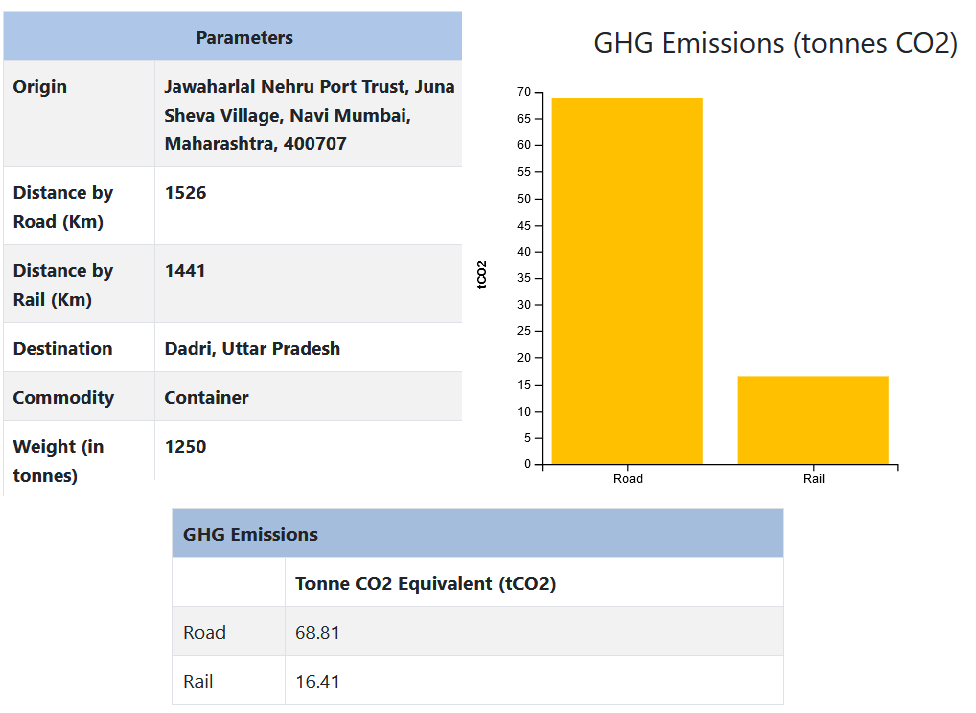
The calculation is done on freightghgcalculator.com, an initiative of the Logistics Division under DPIIT.
The Carbon Credit Ecosystem follows a set of guidelines and protocols for registering and issuing carbon credits, which are established by the standard issuer. Each standard maintains its own registry, and notable examples include CDM, Verra, and Gold Standard. To obtain credits, projects undergo a thorough assessment by a third-party auditor. After issuance, the project developer may either sell the credits to a buyer or utilize them for their own purposes.
As per IEA, Transport as a sector accounted for 37% of CO2 from end‐use sectors globally in 2021 and it could reach as high as 50% by 2030. Yet the transport sector comprises only 0.34% of all registered CDM Projects. The main reason for this low share is the narrow applicability of the Approved Methodologies, complex and time-consuming procedures involved in the quantification of the emissions and the separation between effects caused by the project and the ‘no project’ scenario. The process of turning Carbon Credits from a concept to reality can be challenging, as it often involves upfront investment, lengthy gestation periods, and the possibility of not being approved. Additionally, it may require the creation and submission of new project-specific methodologies. Nevertheless, gradual efforts are being made in the projects where the sheer volume and the large scale of the project make it worthwhile for participation in carbon markets.
Recently NCRTC which is implementing Regional Rapid Transit System (RRTS) project across the NCR also invited bids for assessing the potential of Carbon Credits. DFCs - from Ludhiana to Dankuni (EDFC) and Dadri to JNPT Mumbai (WDFC) - are expected to make freight movement – less carbon and energy intensive. With commissioning expected to be completed by Mar’24, DFC alone is estimated to lessen Carbon Emissions by 455 million tonnes over a 30-year period.
Indian Railways' commitment to achieving complete electrification by December 2023, reaching net-zero emissions by 2030, and boosting the railway's share in freight transport to 45% by 2030 - creates a distinctive prospect to utilise carbon markets and monetise sustainability. As per IETA Estimates, trading in carbon credits could reduce the cost of implementing countries’ NDCs by more than half – by as much as $250 billion by 2030. Thus, in addition to financial gains, participation in Carbon Credits projects also showcases the inherent advantage that Railways and DFCs offer in decarbonising freight transport in India.
Views expressed are personal.
Written by:
On Deputation to DFCCIL as Deputy General Manager (Finance)
Article was published in TheHindu Business Line on 18.04.2023
Link: https://www.thehindubusinessline.com/opinion/for-carbon-credits-turn-to-railways/article66752282.ece